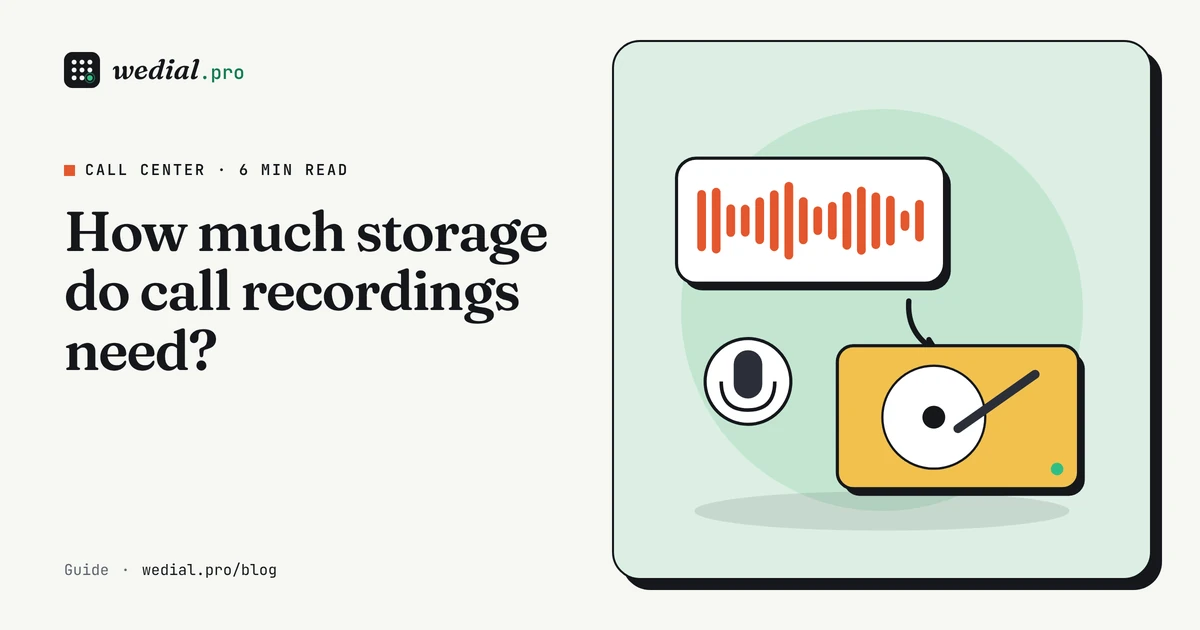
How much call recording storage you need is simple arithmetic, and it surprises people because it adds up fast.
Size = bit rate × length. A 64 kbps recording is 8 KB a second, which is 28.8 MB an hour for one audio channel. This guide shows call recording file size for common formats, a worked example for a 20-agent team, and how the retention period decides the total.
Call recording file size per hour
| Format | Bit rate (per channel) | One hour, mono | One hour, stereo |
|---|---|---|---|
| Uncompressed WAV, 16-bit 8 kHz | 128 kbps | 57.6 MB | 115.2 MB |
| G.711 / µ-law WAV | 64 kbps | 28.8 MB | 57.6 MB |
| MP3 | 32 kbps | 14.4 MB | 28.8 MB |
| Opus | 24 kbps | 10.8 MB | 21.6 MB |
| GSM 06.10 | 13 kbps | 5.85 MB | 11.7 MB |
Stereo here means the caller and the agent are on separate channels, so the file holds twice the audio data. Many call center recorders do it that way because it makes it easier to separate the two voices for transcription and scoring.
These are the rough sizes. Real files differ a little: containers add headers, some recorders suppress silence, and variable bitrate formats such as Opus vary with the speech. Use the figures to plan, and check them against a sample of your own recordings.
A worked example
A team of 20 agents, each on calls for 5 hours a day, working 22 days a month, records everything at 64 kbps stereo:
- Recorded hours: 20 × 5 × 22 = 2,200 hours a month.
- Storage: 2,200 × 57.6 MB = 126.7 GB a month.
- Kept for 12 months: about 1.5 TB (1,521 GB).
The recording storage calculator does this for your own numbers. Here is how the same team compares under different choices:
| Choice | New recordings per month | Stored after 12 months |
|---|---|---|
| 64 kbps stereo, record every call | 126.7 GB | 1,520.6 GB |
| 32 kbps stereo, record every call | 63.4 GB | 760.3 GB |
| 32 kbps mono, record every call | 31.7 GB | 380.2 GB |
| 32 kbps mono, record half the calls | 15.8 GB | 190.1 GB |
The cheapest option stores one-eighth of the most expensive one. Whether you can use it depends on your audio-quality needs and your compliance rules.
Retention is the multiplier
Storage grows until your retention period is reached and then stays level, as old recordings are deleted at the same rate new ones arrive. So the retention period is the biggest lever you have:
- Six months instead of 12 halves the steady-state total.
- Different periods for different queues, for example longer for regulated calls and shorter for routine ones.
- A legal hold, where specific recordings are kept for a dispute, should override the normal schedule for those calls only.
What it costs
Storage cost is roughly gigabytes kept × price per gigabyte per month, and the price depends entirely on where the recordings live. For illustration only, with a placeholder price of 0.02 per GB per month, 1,520 GB would cost about 30 a month. Your phone provider may include storage in the plan, or charge for it separately, so compare it with the cost of keeping the files in your own cloud storage.
Retention is not only a cost question
Recordings can contain personal data, and keeping them longer than you need can create obligations. Privacy rules such as the GDPR include a principle that data should be kept no longer than necessary for its purpose. Set a written policy, follow it, and delete on schedule. Rules on recording and consent vary by country and state: see our call recording guide.
If agents take card payments by phone, you also need a way to pause recording while card details are spoken, so they are never stored.
Where the recordings live
- With your phone provider. Simple, but plans often set retention limits, for example one month on a basic plan and longer, or unlimited, on higher ones. Check the limit and whether you can export.
- In your own storage. More control over retention and cost, with more work to set up.
- A mix. Keep recent recordings where they are quick to search, and move older ones to cheaper archive storage.
Transcripts are cheap
A transcript is plain text, a few kilobytes per call against megabytes for the audio. Some teams keep transcripts and summaries for much longer than the recordings themselves, which keeps the searchable record while the audio is deleted on schedule. Check that your privacy rules allow it.
Choosing a bit rate
Ordinary phone calls are narrowband audio, which is why 8 to 64 kbps is enough for speech. Higher rates are mostly wasted on a narrowband call, so uncompressed recording at 128 kbps buys little over G.711 for most uses. If you plan to transcribe calls or run speech analytics, test the format on a sample before you commit, because very heavy compression can lower the accuracy of both transcription and listening. Pick the lowest bit rate that still sounds clear to the people who will use the recordings.
Estimating in your head
A quick rule for the common case: recorded hours × 57.6 MB gives the stereo G.711 size, and half that for mono. So 100 recorded hours is about 5.8 GB in stereo. Multiply by the months you keep recordings for the steady-state total.
Common estimating mistakes
- Counting paid hours, not recorded hours. Only the time on calls is recorded, not time waiting or in wrap-up. Use talk time.
- Forgetting that queue and IVR time may be recorded too, on some systems.
- Ignoring growth. More agents and longer calls mean more storage next year.
- Forgetting backups and copies, which multiply the total.
- Assuming the vendor's "unlimited" has no retention limit. Read the terms.
Tips for keeping it manageable
- Record the calls you need, not everything by habit.
- Use the lowest bit rate that is still clear for your purposes, and test it with someone who will listen to the calls.
- Decide retention per queue, and write it down.
- Make sure you can search and export, so storing recordings does not mean losing them.
- Review the numbers every so often: headcount and talk time change, and so does the total.
Working out your numbers first makes the conversation with a provider about retention and price much easier.
FAQ
How big is a five-minute call recording?
About 2.4 MB at 64 kbps mono, or 4.8 MB in stereo with each side on its own channel. A 32 kbps recording is half that.
Should I record in stereo or mono?
Stereo doubles the size but keeps the caller and the agent on separate channels, which usually helps transcription and quality scoring. Mono at a lower bit rate is the cheapest way to store calls.
How long should I keep recordings?
As long as your compliance, training and dispute needs require, and no longer. Write down a retention policy and delete on schedule.
How big is a call transcript compared with the audio?
Tiny. A transcript is plain text, a few kilobytes for a typical call, while the audio is megabytes. Keeping transcripts is cheap, which is why some teams keep them longer than the recordings.
Backend engineer who has built VoIP platforms on Asterisk, with years of Laravel and AWS work behind them. More about us