Outbound calling feels like a numbers game because it is one. If you know your rates, you can work out in advance how many dials it takes to book a meeting, how many a sales goal needs, and how many reps it takes to make them. This guide shows the cold calling funnel, a worked example, how sensitive it is to each rate, and how to find your own numbers.
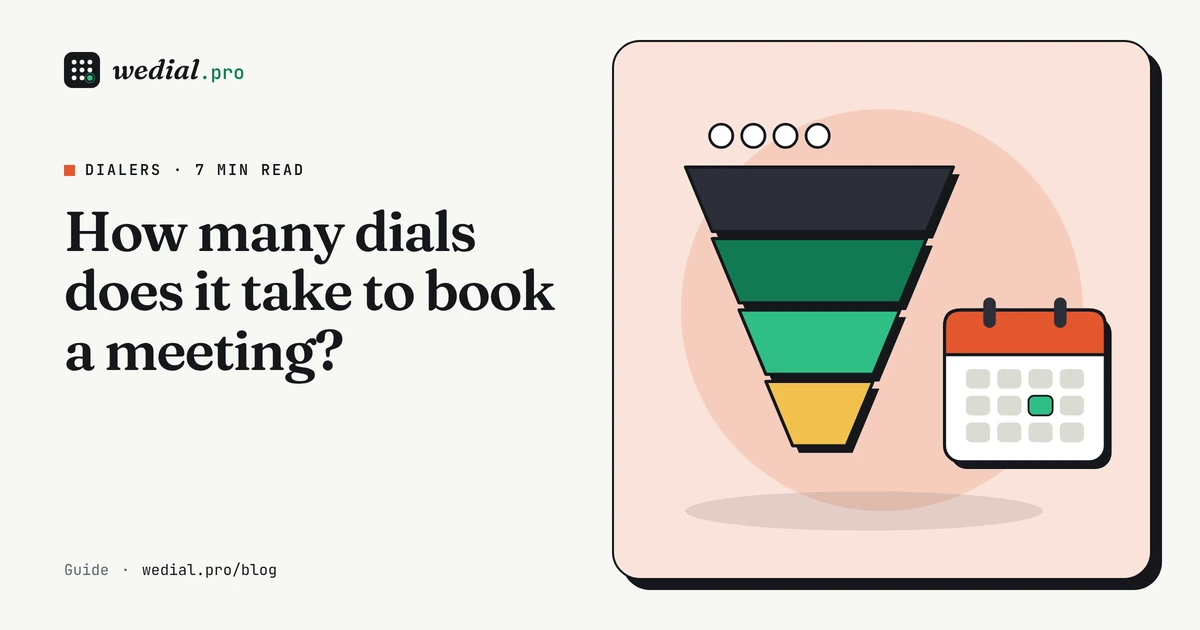
The funnel
Each stage feeds the next:
- Dials reach a live person some of the time (the answer rate).
- Live conversations lead to a meeting some of the time (the meeting rate).
- Meetings become sales some of the time (the close rate).
To go from a goal to dials, work backwards:
- Meetings needed = sales ÷ close rate
- Conversations needed = meetings ÷ meeting rate
- Dials needed = conversations ÷ answer rate
A worked example
Suppose you want 10 sales a month, and these are your rates (placeholders for the example, not benchmarks):
- 20% of meetings close.
- 10% of live conversations book a meeting.
- 8% of dials reach a live person.
Then:
- Meetings: 10 ÷ 0.20 = 50
- Conversations: 50 ÷ 0.10 = 500
- Dials: 500 ÷ 0.08 = 6,250
That is 625 dials per sale. Over 21 calling days it is about 298 dials a day, which is 3 reps at 100 dials each. The cold-call funnel calculator does this for your own numbers.
Why the top of the funnel matters most
Change one rate and see what happens to the dials. Here is the number of dials needed for 10 sales a month with a 20% close rate:
| Answer rate | Meeting rate 8% | 10% | 12% | 15% |
|---|---|---|---|---|
| 6% | 10,417 | 8,334 | 6,950 | 5,567 |
| 8% | 7,813 | 6,250 | 5,213 | 4,175 |
| 10% | 6,250 | 5,000 | 4,170 | 3,340 |
| 12% | 5,209 | 4,167 | 3,475 | 2,784 |
Read across and down:
- Answer rate from 8% to 10% (meeting rate 10%): dials fall from 6,250 to 5,000, a 20% drop.
- Meeting rate from 10% to 12% (answer rate 8%): dials fall to about 5,213, a 17% drop.
- The close rate matters too: at 15% you need 8,375 dials for the same 10 sales, and at 25% only 5,000.
Each stage multiplies the others, so improvements at every stage add up, and a gain at the top removes dials, not just conversations.
What moves each rate
Answer rate
- List quality: accurate, recent numbers and the right contacts.
- When you call. Test different times, and use the best time to call tool for different time zones.
- Number reputation. Numbers that get labelled as spam are not answered. See local presence and number rotation.
Meeting rate
- The opening, the offer and who you reach.
- Follow-up. Many meetings come from a second or third touch, such as a voicemail drop followed by a call back.
Close rate
- Mostly your product, your qualification and the meeting itself, not the dialer.
Dials per rep
- A power dialer removes the time spent finding and typing numbers, so a rep spends more of the day in conversations. See the dialer comparison.
Averages hide what works
One blended rate across very different lists hides what is going on. Suppose you dial two lists of 3,000 numbers each:
| List A | List B | |
|---|---|---|
| Dials | 3,000 | 3,000 |
| Live conversations | 300 (10% answer rate) | 180 (6% answer rate) |
| Meetings booked | 24 (8% of conversations) | 27 (15% of conversations) |
| Meetings per 1,000 dials | 8.0 | 9.0 |
List A is easier to reach but converts worse. List B is harder to reach and converts much better, and gives more meetings for the same dials. The blended figures (8% answer rate, about 10.6% meeting rate) describe neither list. Segment by list, source, time of day and rep, and invest where meetings per dial is highest.
Getting your own rates
Pull these from your dialer and CRM over a few weeks:
- Total dials and dials answered by a person.
- Live conversations and meetings booked from them.
- Meetings held and deals closed.
Segment by list or campaign, and make sure you are counting the same thing at each stage (for example, whether an answered call that is a wrong number counts as a live conversation).
How many conversations before you trust a rate
Small samples mislead. With 100 conversations and a true meeting rate of 10%, you would expect about 10 meetings, but the normal swing is about 3, so a range of roughly 4 to 16 meetings is entirely ordinary. With 500 conversations the swing is about 7, so the range tightens to roughly 37 to 63 meetings on an expected 50. Don't change a script because one afternoon looked bad. Wait for a few hundred conversations before you decide.
Beyond dials: attempts and cadence
The funnel treats each dial as separate, but real contacts get several attempts. Plan a cadence, for example call, voicemail drop, follow-up email, then call again on another day and at a different time. Track meetings per contact, not just per dial, to see whether the third attempt is worth making.
A weekly review routine
Once a week, pull the same short report and look at the same numbers:
- Dials, answer rate, conversations, meetings and meetings per 1,000 dials, by list.
- The same figures by rep, to find habits worth copying.
- The same figures by time of day and day of the week.
- Any list whose answer rate has dropped sharply, which can mean a reputation problem with your numbers.
Keep a simple log of what you changed each week, so you can connect a change in the numbers to its cause.
Test one change at a time
If you change the script, the list and the calling time all at once, you won't know which one made the difference. Split a list in two, change one thing for half, and compare meetings per 1,000 dials once both halves have a few hundred conversations. The same applies to voicemail messages and follow-up timing.
Caveats
The funnel is an average. It will not tell you which reps, lists or times are best, and rates shift when you change the script or the list. Use it to plan and to spot where you are leaking, then check it against what actually happens.
FAQ
Where do I find my answer rate?
In your dialer's reports: dials that reached a live person divided by total dials. Use a few weeks of data, by list or campaign.
Should I use industry averages for my rates?
Use them only as a rough sanity check. Rates vary with list quality, offer, country and time of day, so your own history is a better guide.
Why does a small change in answer rate matter so much?
Because it sits at the top of the funnel and multiplies everything below it. A better answer rate means fewer dials for the same number of conversations.
How many conversations do I need before I trust a rate?
As a rough guide, a few hundred. With 100 conversations at a 10% meeting rate you would expect about 10 meetings, give or take 6, so the true rate could be anywhere from about 4% to 16%.
Backend engineer who has built VoIP platforms on Asterisk, with years of Laravel and AWS work behind them. More about us